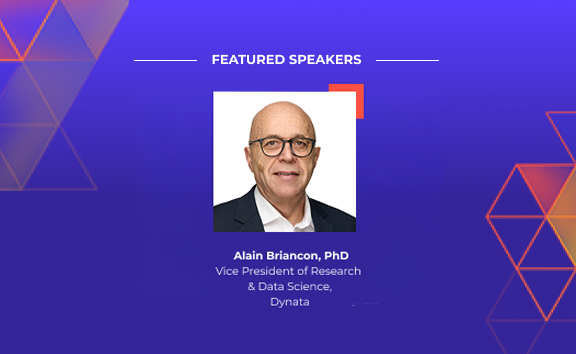
Synthetic data has been gaining buzz across industries – from healthcare to automotive – and it’s finally reaching a tipping point in market research. But while the hype is real, so are the misconceptions. As Dynata’s VP of Research and Data Science, Dr. Alain Briançon, emphasized in our recent webinar, the biggest misunderstanding is also the simplest:
There is no single thing called “synthetic data.”
There are only synthetic data systems — built for very specific purposes.
And that distinction changes everything about how researchers should evaluate, trust, and apply synthetic data today.
This post breaks down the big ideas from Alain’s presentation and translates them into plain language and practical guidance — so you can understand not just the theory, but how to apply synthetic data meaningfully in your day today work.
1. Why synthetic data matters now – especially for market research
Across industries, synthetic data solves problems we run into constantly:
- Scarce respondents
Niche segments, low incidence audiences, or rare behaviors are often slow or expensive to field.
- Privacy barriers
Regulations like GDPR and growing client sensitivity make it harder to share or merge datasets.
- Operational bias
We tend to capture the majority, but not the minority – and bias creeps into insights.
- Slow iteration cycles
Sometimes you just don’t have time to wait for sample to trickle in.
Synthetic data helps, but only when the right method is matched to the right purpose.
For example, generating a thousand “extra” Gen Z respondents might help you understand purchase drivers…
…but those same synthetic Gen Z respondents may be completely useless for stress testing a mobile centric ad campaign.
This is why purpose is the recurring theme.
Synthetic data earns its value when it’s purpose-built.
2. Four synthetic data use cases researchers can actually apply today
Alain outlined a practical taxonomy — and the good news is, most of these use cases map cleanly onto the work market researchers already do.
Below are the big four, in plain language.
Use Case 1: Imputation – Filling in missing answers
What it is:
When respondents drop off or skip questions, synthetic models can fill in the gaps using patterns learned from those who did answer.
Where it helps you:
- Salvaging partial completes
- Reducing bias from unanswered items
- Avoiding manual guesswork or crude averaging
In practice:
If 20% of respondents bail at Q25, imputation can recover those answers without you needing to rerun fieldwork.
Use Case 2: Boosting – Expanding hardtoreach groups
What it is:
Artificially increasing the number of respondents in a niche audience (e.g., lefthanded dentists in Canada under age 35).
Where it helps you:
- Low incidence groups
- Hardto-reach audiences
- Segments that need fuller representation for modeling
In practice:
If your N=32 Hispanic Gen Z parents isn’t enough to run reliable cuts, boosting can expand it – as long as the original data contains enough signal.
Use Case 3: Enrichment – Adding attributes you didn’t capture
What it is:
Appending new variables (demographics, behaviors, attitudes) based on correlations learned from other data sources or past surveys.
Where it helps you:
- Segmentation
- Audience activation
- Filling gaps in legacy data structures
In practice:
If you didn’t ask about household income, but it’s strongly predictable from other answers, enrichment can add it back in — creating more complete respondent profiles.
Use Case 4: Digital twins & personas – Predicting answers never asked
What it is:
Generating synthetic “twins” of real respondents to answer additional questions they never saw.
Where it helps you:
- Early concept testing
- Persona creation
- Simulating reactions before fielding
In practice:
You can forecast how an audience would respond to new ideas without fielding a new study – powerful for iterative or exploratory research.
3. The Pitfalls: What researchers need to watch out for
Alain was clear: synthetic data is powerful, but it’s not magic.
Here are the biggest risks researchers should be aware of.
Pitfall #1: Overreliance on simple statistics
Averages and correlations can’t capture human complexity.
Synthetic data built only on “the mean respondent” produces nonsense.
Alain illustrated this with a clever example:
If you averaged a series of artistic interpretations of the Mona Lisa for a phone case, you’d end up with… a blurry composite no one wants.
What this means for you:
If you see synthetic output that looks “too smooth,” too average, or too homogeneous, it’s a red flag.
Pitfall #2: Missing structural patterns
Real human data is messy, nonlinear, and patterned in subtle ways – think:
- Shaped generational interest curves
- Midmarket “diamond” price sensitivity
- Cyclical behavior (like time of day purchase rings)
- Distinct clusters that resemble segments
Basic synthetic models miss these patterns entirely, because correlations alone cannot detect structure.
What this means for you:
Ask your sample supplier partner:
“How does your synthetic method preserve structural patterns?”
If they can’t answer that plainly, walk away.
Pitfall #3: Assuming all use cases are valid
The same synthetic dataset might:
- Work beautifully for understanding purchase drivers
- Fail miserably for optimizing mobile ad delivery
Purpose determines validity.
What this means for you:
Never treat synthetic data as general-purpose.
Always ask:
“Is this synthetic approach appropriate for the business question?”
4. The Trinity of Quality: Fidelity, utility, and privacy
Dynata’s stance on synthetic data revolves around three non-negotiables:
1. Fidelity
Does the synthetic data look and behave like the real data – in the ways that matter?
Fidelity isn’t about perfection.
It’s about functional equivalence for the specific use case.
2. Utility
Does the synthetic data actually help answer the question at hand?
Example:
Great fidelity doesn’t matter if the synthetic respondents don’t help you make a better decision.
3. Privacy
Does it protect both the respondent and the client?
Two levels matter:
- No ability to reverse-engineer an individual
- No cross-client data leakage
Dynata treats both as mandatory.
5. How to evaluate synthetic data: A practical checklist for researchers
You don’t need a PhD to evaluate synthetic data — but you do need the right questions.
Here’s a simple checklist you can use with any sample partner:
✔️ Purpose fit
- What specific use case is this synthetic data designed for?
- Has this method been validated for this purpose?
✔️ Fidelity indicators
- Does it preserve key distributions and relationships?
- Does it reproduce known behavioral patterns?
✔️ Utility indicators
- Does the synthetic output lead to actionable recommendations?
- Does it improve modeling, segmentation, or prediction?
✔️ Privacy safeguards
- How is individual re-identification prevented?
- How is client level data isolated?
✔️ Transparency
- Can the provider clearly explain the method in plain language?
If any answer feels vague, generic, or evasive — treat it as a warning sign.
6. Why Dynata’s approach is different
Dynata grounds synthetic data in:
- High-quality, first party respondent data
- Clear privacy guardrails
- Human in the loop validation
- Rigorous, purpose-driven quality assessment
- A taxonomy that aligns with real MR workflows
Synthetic data isn’t replacing respondent data.
It’s extending it – responsibly, safely, and with measurable quality standards.
7. What comes next for market researchers
Synthetic data is not replacing qualitative discovery.
It’s not replacing fieldwork.
And it’s not replacing the craft of research design.
What it is doing is expanding what’s possible:
- Faster insight cycles
- More complete datasets
- Richer personas
- Better pretests
- More resilient segmentation
- And yes — efficiencies that help you do more with less
As Alain put it:
Quality is the North Star — for human data, and now for synthetic data.
When synthetic data is used thoughtfully, validated carefully, and applied purposefully, it becomes a powerful extension of the researcher’s toolkit.
And Dynata is building the systems to make that future reliable, responsible, and ready for real-world decision-making.