

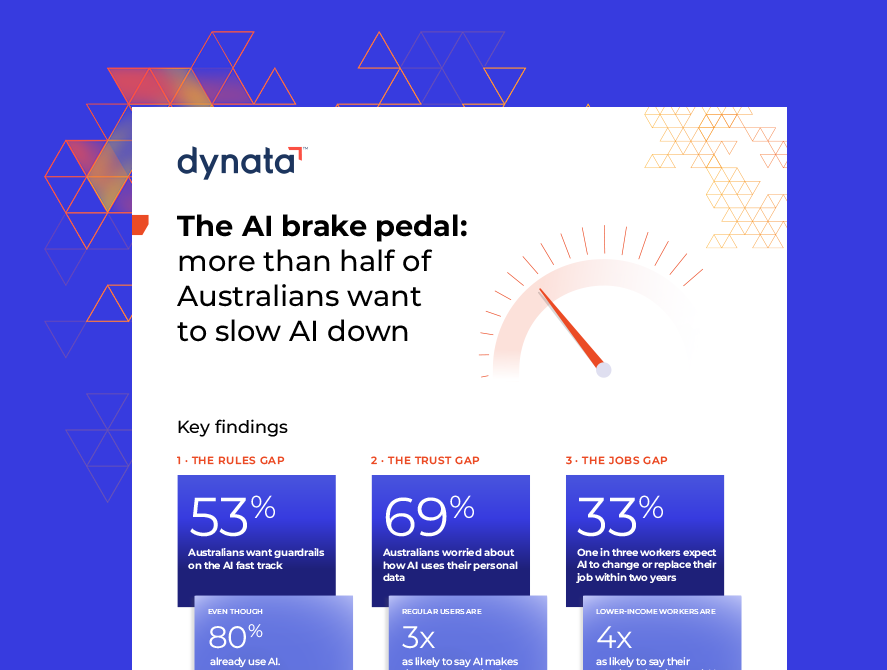
The AI brake pedal: more than half of Australians want to slow AI down
Eight in 10 Australians use AI. More than half want it slowed down. Here’s what else they told us.
Key findings
- Australians want guardrails on the AI fast track
Despite 80% using AI tools, more than half (53%) want advanced AI development slowed until stronger safety rules are in place, and 61% want an Australian body to set the rules.
- Australians use AI, but trust is lagging behind
Regular users are three times as likely to say AI makes them more productive. But nearly seven in 10 (69%) worry about how AI tools use their personal data.
- One in three workers see a two-year countdown
33% expect AI to significantly change or replace their job within two years. And workers in households earning under $70K are four times as likely as those in $150K-$199K to say their employer has ignored AI.
More than half of Australians (53%) want advanced AI development slowed until stronger safety rules are in place.
That’s despite most of us being knee-deep in AI already: 80% of us now use AI tools, and regular users are three times as likely to say it makes them more productive.
We surveyed 1,037 Australians in October 2026. The results point to three tensions that stand out: who sets the rules, whether we trust AI, and the divide at work.
Part 1. The rules gap: pushing back on the AI sprint
For most people, the question isn’t whether to use AI. It’s who is actually responsible for drawing the regulatory lines.
Who draws the line?
Six in 10 (61%) want an Australian body in charge: 34% back the federal government, and 27% want an independent regulator. Only 8% worry that strict local rules would slow progress.
Privacy comes first
Privacy tops the list of AI priorities. Over half (51%) chose protecting personal data and privacy, ahead of protecting Australian jobs (38%) and tackling AI-generated misinformation and deepfakes (35%).
It’s not only about privacy. There’s also a call for creative fair play: a third (34%) say Australian creators and media should be paid when AI tools are trained on their work, such as news, books and other creative content.
In short, most people want AI rules set here in Australia, with privacy first. But rules are only part of the story. Trust is another.
Part 2. The trust gap: we use it, but we don’t trust it
AI has gone mainstream. 80% of Australians use it; 61% regularly and 19% occasionally. Regular use is highest among 18–24-year-olds (79%) and $200K+ earners (80%) and lowest among over-55s (39%).
The more we use it, the more we rate it. Regular users are three times as likely to say AI makes them more productive (75% vs 24% of occasional users). They’re twice as likely to trust what it tells them (55% vs 26%). They’re also less keen to slow it down. Across all Australians, 53% want the brakes on, but that varies with use: 74% of non-users and 60% of occasional users, compared with 44% of regular users. It points to a momentum loop: the more people use AI, the more value and confidence they seem to get from it, and the less they want to slow it down.
AI is moving fast, but has trust kept up? Nearly seven in 10 Australians (69%) are worried about how AI tools use their personal data.
So can trust catch up with how quickly we’re using it?
Part 3. The jobs gap: who’s getting help to adapt
How worried are Australians about their jobs? One in three Australian workers (33%) expect AI to significantly change or replace their job within two years.
That view is most common among two groups: 18–24-year-olds and mid-high earning families with $150K-$199K annual household income.
The future of work is arriving, but not evenly. Only 29% of employees say their employer actively encourages AI and provides training. Who gets the support varies with household income: a third (34%) of workers in households earning under $70K say their employer has completely ignored AI, compared with just 8% in $150K-$199K households.
Lower-paid workers are four times as likely to say their employer has ignored AI. This suggests AI upskilling may be reaching higher earners first, leaving many lower-paid workers to adapt on their own.
Are organisations helping everyone adapt, or only some?
Not “no”, just “not like this”
Most Australians are already using AI. What many want now are stronger safeguards: protection of their personal data, Australian oversight, and safety rules in place before advanced AI develops further.
Australians aren’t slamming the brakes on AI. They’re asking for a steadier hand on the wheel.
We’ll keep tracking how attitudes change as AI moves further into our homes and workplaces.
Want to know what Australians think about the issues that matter to your organisation? Talk to us about running your own survey. Contact us at Dynata.